


 English

Honeycomb blinds are known for their distinctive cellular structure, but the performance of the finished blind depends heavily on the material used to create the cells. Different materials can affect light control, durability, appearance, flexibility, and insulation performance.
For blind manufacturers and buyers, understanding the honeycomb blind material is therefore an important part of selecting the right fabric for different window covering applications.
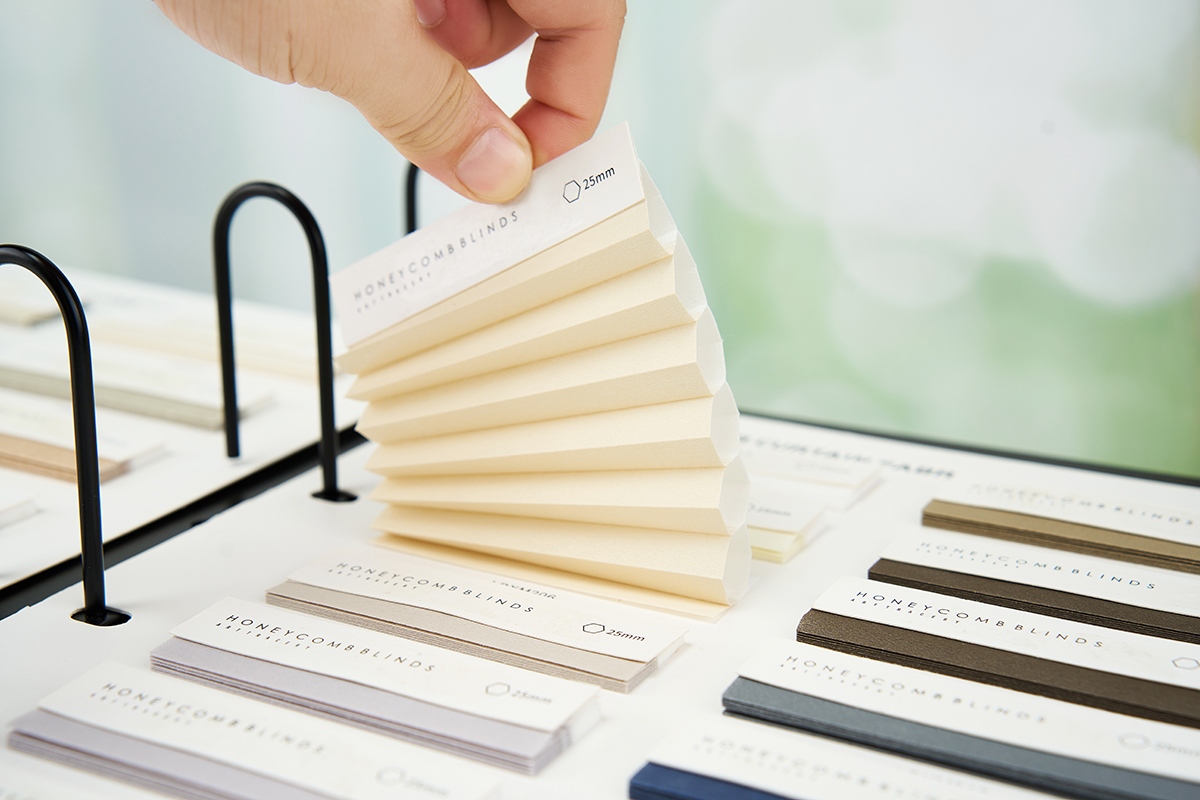
1. Polyester Is a Common Material for Honeycomb Blinds
Polyester is widely used in cellular and honeycomb blind fabrics because it can provide a suitable combination of strength, flexibility, dimensional stability, and processing performance.
Polyester fabric can be manufactured in different structures and finishes depending on the requirements of the finished blind. It can also be processed into different cell sizes and configurations for various window covering applications.
For manufacturers, material stability is particularly important because the fabric needs to maintain consistent folds and cell structures during production and repeated operation.
2. Non-Woven Polyester Fabric
Non-woven polyester is one of the commonly used material types for honeycomb blinds. Instead of forming the fabric by interlacing yarns, non-woven materials are produced by forming and bonding fibers into a sheet structure.
Different bonding technologies can be used to achieve the required strength, flexibility, surface appearance, and dimensional stability.
Non-woven polyester can be suitable for honeycomb blinds because it can be processed into stable pleats and cellular structures while remaining relatively lightweight.
3. Spunlace Non-Woven Material
Spunlace is another material structure used for Cellular Shade Fabrics. In this process, fibers are mechanically entangled to form a non-woven sheet.
Spunlace materials can provide a soft surface and good flexibility while maintaining the structural characteristics required for pleated window covering fabrics.
Depending on the manufacturing specification, spunlace polyester can be used for light-filtering, room-darkening, and other honeycomb blind applications.
4. Point-Bonded Non-Woven Material
Point bonding is another method used to create non-woven honeycomb blind fabric. Fibers are bonded at specific points to create a stable sheet structure.
This type of material can provide useful dimensional stability and support consistent pleating. The bonding pattern and production parameters can be adjusted according to the required fabric characteristics.
For manufacturers, the choice between different non-woven structures can depend on the required softness, strength, pleat memory, appearance, and processing performance.
5. Woven Polyester Fabric
Some honeycomb blind products can also use woven polyester fabrics. Woven materials are produced by interlacing yarns through a textile weaving process.
Compared with non-woven structures, Woven Fabrics can provide a different surface texture and visual appearance. The choice depends on the product design and the performance requirements of the finished blind.
When selecting woven material, manufacturers may consider fabric density, yarn structure, surface finish, flexibility, and dimensional stability.
6. Blackout and Coated Materials
Honeycomb blind fabrics can also be manufactured with additional coatings or laminated layers when stronger light-blocking performance is required.
A blackout structure may use a base fabric combined with an opaque or reflective layer. This additional layer can reduce light transmission and can also influence the appearance and thermal characteristics of the finished fabric.
Different coating and lamination technologies can be selected according to the required level of light control and the target application.
7. How Material Affects Light Control
The material structure has a direct influence on how much light passes through the blind. Light-Filtering Fabrics can allow diffused daylight into a room, while darker or coated materials can provide stronger light reduction.
Manufacturers can combine material selection with color, coating, and cellular structure to achieve different levels of light control.
This makes material selection particularly important for bedrooms, conference rooms, offices, hospitality projects, and other spaces with specific privacy or lighting requirements.
8. How Material Affects Insulation
The honeycomb structure itself creates enclosed air spaces within the blind. These cells provide a layer between the window and the interior space.
However, the fabric material also contributes to the overall structure and stability of the cells. A material with suitable dimensional stability can help the blind maintain its cellular configuration during regular use.
Single-cell and double-cell configurations can also be produced depending on the required product design and performance characteristics.
9. Material Selection for Different Applications
| Application | Material Considerations | Typical Requirement |
|---|---|---|
| Residential windows | Appearance, flexibility, light control | Light-filtering or room-darkening fabric |
| Bedrooms | Privacy and light blocking | Blackout or darker fabric |
| Office spaces | Light diffusion and appearance | Light-filtering fabric |
| Hotels | Durability and consistent appearance | Stable cellular fabric |
| Commercial projects | Consistency and customization | Bulk-production suitable material |
10. What Should Buyers Check When Selecting Honeycomb Blind Material?
Buyers should not evaluate a fabric only by its appearance. Important specifications may include material composition, fabric weight, cell size, cell structure, light-control level, width, color consistency, pleat stability, and dimensional stability.
For bulk orders, buyers should also confirm production consistency and available customization options. Different markets may require specific colors, finishes, fire-retardant properties, environmental certifications, or other product specifications.
The materials used for honeycomb blinds can include polyester-based Non-Woven Fabrics, spunlace materials, point-bonded materials, woven polyester, and coated or laminated fabric structures.
The right material depends on the required appearance, light control, durability, cellular structure, and application. For blind manufacturers and wholesale buyers, understanding material characteristics before production can help create honeycomb blinds that meet specific market and project requirements.